South African intervention in the Angolan Civil War
Another Day of LifeThe South African intervention in the Angolan Civil War is presented as a decisive change in the character of the conflict, not merely an additional advance across a border. The book dates the first entry of South African troops into Angolan territory to 27 August 1975, in the Cunene region. A skirmish there killed Comandante Kalulu, the MPLA commander of the southern front. The intervention also altered the scale of the war: what had been primarily a domestic guerrilla struggle fought with light weapons was increasingly a war of regular armies and heavy equipment.
Background and first entry
The chronology identifies 27 August 1975 as the first South African military entry into Angola. The location was the Cunene region, far from the northern front around Luanda that dominates much of the book’s immediate reporting. This southern entry placed the Republic of South Africa directly inside the conflict rather than leaving it as a distant presence in the surrounding political struggle.
The first recorded encounter was a skirmish. Its consequence was immediate for the MPLA’s command structure: Comandante Kalulu, commander of its southern front, was killed. The account does not provide the size of the South African force, the duration or precise course of the engagement, or a detailed operational objective. Its brief chronology instead marks the crossing and the commander’s death as the essential facts of the intervention’s opening.
A change in the kind of war
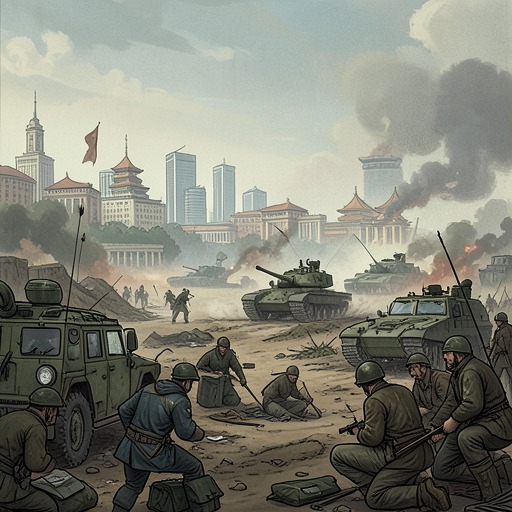
The book gives the intervention a significance beyond that initial encounter. In a later assessment, it contrasts the earlier conflict—a primarily guerrilla war fought domestically with light weapons—with the increasingly conventional war that followed South African involvement. The change is described in terms of regular armies and heavy equipment. The intervention thus marks a transition in the conflict’s military form, from fighting chiefly by guerrilla forces toward engagements shaped by larger, more conventionally equipped forces.
That transformation is connected to the young republic’s continuing military predicament. The account does not claim that the intervention alone explains every battle or every later shift in control. Rather, it identifies South African intervention as the point at which the war’s military character changed, while emphasizing that the republic remained in a difficult position. The distinction matters: the book presents a consequential escalation, not a simple account in which the arrival of a foreign army determines the outcome by itself.
The widening fronts and the information war
The opening on the southern front unfolded amid a conflict whose reports and claims were already contested. In September, leaflets dropped over Luanda asserted that Holden Roberto’s army was outside the capital and would soon enter it. They urged the population to kill Russians, Hungarians, and Poles, falsely presenting them as the cause of the war and the country’s misfortunes. The narrator reports that he was then the only person from Eastern Europe in Angola. These leaflets document the atmosphere of threat and propaganda, but they do not identify the South African troops or establish that the forces in the southern and northern campaigns were the same.
The book also shows how the MPLA’s account of the fighting changed with its fortunes. Comandante Ju-Ju’s radio communiqués were brief and calm when events seemed favorable; when the situation worsened, they became longer and more emphatic. The narrator read their length and tone as clues to developments he could not otherwise see. By November, he found the communiqués strikingly optimistic against his assessment that half the country was in enemy hands. The contrast reveals the difficulty of understanding a war fought across multiple fronts, where public statements could reassure supporters while obscuring the gravity of the military position.
Consequences in a country under pressure
The intervention’s conventional turn belongs to a wider breakdown of ordinary life, although the book does not attribute each instance of that breakdown directly to South African action. Portuguese residents were leaving Angola in large numbers; people crowded the Luanda airport, where many waited without knowing when or where they would be flown. Later, news reached the hotel that the police had left the city. Garbage collection also stopped, and refuse accumulated in the abandoned streets. These episodes show the civilian and institutional conditions surrounding the military change: the conflict was not only a contest between armed forces but a crisis in which population flight and the disappearance of public services reshaped daily life.
On 4 November, armed men entered the hotel where the narrator was working, demanded a list of guests, and brought frightened residents downstairs for questioning. The MPLA press chief eventually ordered the men to release them. That same entry records a quiet northern front while forces waited for troops from the south to draw nearer, with an attack from two sides anticipated. The passage establishes an expectation of coordinated pressure, not a full account of its execution. On 11 November, as Luanda marked independence, a dispatch to Warsaw described the South African Army’s intervention as having changed the war from a mainly domestic guerrilla conflict into one increasingly fought by regular armies with heavy equipment.
Significance
The intervention’s narrative weight rests on the conjunction of a dated border entry, a named battlefield loss, and a broader military transformation. The first South African troops entered in the south on 27 August; the skirmish killed the MPLA southern-front commander; and the war thereafter was described in terms of regular armies and heavier weapons. The book sets these facts alongside northern-front uncertainty, propaganda, strained public order, and the later declaration of independence, without reducing those developments to a single cause. South African intervention stands as a turning point in the war’s scale and form, while the fighting and instability around it remain part of a wider, contested conflict.